Buying a film blowing machine is not like buying a standard workshop tool. It is a long-term production decision that affects material cost, scrap rate, output stability, and even the types of customers you can serve. We often meet buyers who start with a simple goal—“We want a machine for PE film”—and then discover the real questions: Which resin mix? What film thickness range? What output per hour? How stable does gauge need to be? Do we need ABA or ABC layers? How much automation is worth the investment? If these questions are not clarified early, it’s easy to end up with a machine that runs, but does not run efficiently. In blown film, small performance differences quickly become large cost differences because production runs for thousands of hours and consumes tons of resin.
From our perspective at Wenzhou Huachu Machinery Co., Ltd., the “right” film blowing machine is the one that matches your real product mix and growth plan. A machine optimized for high-speed packaging film is different from one designed for thicker industrial liners. A machine built for stable thin film requires different cooling, air ring, and die performance than a machine built mainly for thick film. This selection guide explains the key technical choices in clear terms and shows you how to choose a film blowing machine that fits your production needs today, while still leaving room for future upgrades.
Step 1: Define Your Film Products and Market Requirements
Start from your end product. The machine must match what your customers actually buy.
Key questions to answer
What material do you run most: LDPE, LLDPE, HDPE, blends, or recycled content?
What is your film thickness range (microns) and tolerance requirement?
What is your film width requirement (layflat width)?
Do you make bags, liners, shrink film, agricultural film, lamination film, or general packaging film?
Do you need special features like high clarity, high stiffness, good sealing, or puncture resistance?
A clear product definition prevents overbuying features you don’t need—or underbuying stability you will need later.
Step 2: Choose the Right Machine Type for Your Output and Complexity
A film blowing line is usually defined by:
extruder size and screw design
die type and diameter
cooling system (air ring, IBC optional)
haul-off and winding system
control level (manual vs automatic)
Single-layer vs multilayer
Single-layer film blowing machine: cost-effective, simpler to operate, suitable for many general films.
ABA / ABC multilayer machine: better property balance, enables recycled core layer, improves toughness or sealability depending on layer design.
If your customers demand consistent performance at lower material cost, multilayer is often the upgrade path.
Step 3: Match Screw and Extruder Design to Your Resin
The extruder screw is the heart of melting and mixing. Different materials and blends need different screw performance.
What to consider
If you run more LLDPE, you need stable melting and mixing to avoid gel and poor bubble stability.
If you add recycled material, mixing and filtration become more important.
If you target thin film, melt stability and temperature control become more critical.
A good selection is not only “bigger extruder.” It is the correct screw design and heating control for the resin and output target.
Step 4: Decide Your Film Width, Layflat, and Die Diameter
Film width is usually specified as layflat width. The die diameter and blow-up ratio (BUR) influence:
Practical guidance
Wider films require more stable cooling and better winding tension control.
Higher BUR can improve film properties but can also increase bubble sensitivity if controls are weak.
If you plan to produce both narrow and wide films, choose a configuration that supports stable control across your operating window.
Step 5: Focus on Thickness Control and Gauge Consistency
Thickness variation is expensive. It creates:
higher resin usage (over-thickness to stay safe)
customer complaints
unstable bag making performance
roll defects and winding issues
Equipment features that support stable thickness
high-quality die and machining
stable temperature zones and melt control
effective cooling air ring design
optional automatic thickness control (depending on product level)
Quick table: What your quality target suggests
Film requirement | Suggested machine focus | Typical buyer type |
General packaging film | stable basic controls | new producers, general markets |
Thin film with tight tolerance | stronger cooling + control upgrades | export and brand packaging |
High recycled content film | mixing + filtration + stable screw | cost-sensitive high volume |
Premium multilayer film | ABA/ABC + better winding | higher-end converters |
Step 6: Evaluate Cooling System Options for Bubble Stability
Cooling is what allows speed. Bubble stability is what allows quality.
Air ring performance
A stable air ring improves:
bubble shape control
thickness uniformity
output speed potential
IBC (Internal Bubble Cooling)
For higher output thin film lines, IBC can:
Not every line needs IBC. But if you plan to grow into thinner film and higher output, it can be a strategic option.
Step 7: Choose Haul-Off and Winding That Match Your Film Type
Even if extrusion is good, poor winding ruins product value.
Haul-off selection
Winding selection
center winder vs surface winder design concepts
tension control for roll hardness consistency
edge alignment (EPC) if needed
If your customers complain about telescoping rolls, wrinkles, or poor roll hardness, the issue is often in winding, not extrusion.
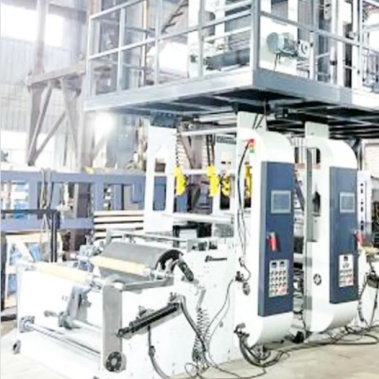
Step 8: Decide Automation Level Based on Your Labor and Quality Goals
Automation is not only for “big factories.” It can reduce waste and stabilize quality even in mid-size plants.
Consider:
automatic temperature control systems
inverter/servo control for stable speed
thickness control systems (for tight gauge)
EPC (edge position control)
online inspection options (for higher-end film)
Cost logic
A higher automation level often pays back through:
reduced scrap during start-up
lower resin over-thickness buffer
fewer operator errors
more stable output across shifts
Step 9: Plan Utilities and Factory Setup Before Purchase
A film blowing machine is a system. It needs:
stable power supply and electrical capacity
adequate cooling air and working space
safe height clearance (tower height)
resin feeding and storage plan
maintenance access
Many installation delays come from site readiness issues rather than machine problems.
Step 10: Ask the Right Questions When Comparing Suppliers
When you compare quotations, focus on what affects long-term production:
what is the realistic output range for your resin?
what thickness tolerance can be supported?
what is included in the die and air ring package?
what winding system is used and why?
what spare parts and support are included?
what training is available for stable production?
A supplier that can explain why a configuration fits your product is usually safer than one that only offers a low price.
A Practical Film Blowing Machine Selection Checklist
Category | What to confirm | Why it matters |
Product | resin type, thickness, width | defines machine structure |
Output | kg/h target and growth plan | affects extruder/die/cooling |
Layers | single, ABA, ABC | cost vs performance balance |
Cooling | air ring, IBC option | speed and bubble stability |
Controls | manual vs automation level | scrap and consistency |
Winding | tension control, EPC | roll quality |
Site | height, power, space | smooth installation |
Final Thoughts
A film blowing machine delivers value when it matches your real production goals: the right resin compatibility, the right thickness and width window, stable bubble control, and winding quality that protects roll value. The best selection decisions are made by starting from the product, then building the machine configuration around output, quality tolerance, and automation needs—rather than choosing based on price or extruder size alone. When your machine is correctly specified, you reduce scrap, stabilize thickness, and improve profit per kilogram of resin processed.
At Wenzhou Huachu Machinery Co., Ltd., we support customers with film blowing machine solutions for packaging and industrial film production, with practical configuration guidance based on material, thickness, and output targets. If you’d like help selecting the right line for your production plan, you are welcome to contact us to discuss your film specifications and expected capacity so we can recommend suitable options and technical support.
FAQ
1) What should I consider first in a film blowing machine selection guide?
Start with your film product requirements: resin type, thickness range, layflat width, and target output. These define the correct machine structure.
2) Is a multilayer film blowing machine always better than a single-layer machine?
Not always. Multilayer (ABA/ABC) offers better performance and cost flexibility, but single-layer machines are simpler and cost-effective for many general films.
3) How can I reduce thickness variation on a film blowing machine?
Focus on die quality, stable temperature control, effective air ring cooling, and proper haul-off/winding tension. Automation can further improve consistency.
4) When do I need IBC on a film blowing machine?
IBC is most valuable for higher output and thinner film production where cooling limits speed. If you plan to scale speed and quality, IBC is worth considering.


