Introduction
Have you ever wondered what sets cast film and blown film apart? While both are used in various industries, their production processes result in very different characteristics.
In this article, we’ll explore the key differences between cast and blown film, focusing on how their production methods affect film quality. You’ll also learn about the critical role of the Film Blowing Machine in producing blown films and how it influences their properties and applications.
What is Cast Film?
Cast Film Production Process
The cast film production process begins with extruding molten plastic through a flat die. The molten film is then rapidly cooled as it is pressed onto a chilled roll. The material solidifies quickly, forming a thin, smooth film. This cooling method is crucial for achieving uniform thickness and a smooth surface. The process is typically faster and less energy-intensive than the blown film process, which makes it more cost-effective for producing thin films.
Unlike blown film, which relies on air inflation and biaxial stretching, the cast process involves cooling the material directly onto a flat surface, creating a much smoother finish. This makes cast film ideal for applications where the surface quality is critical, such as flexographic printing and labeling.
The production speed of cast films is another significant advantage. The ability to produce films faster without sacrificing quality helps manufacturers meet high-volume demands efficiently. Additionally, cast films typically exhibit better transparency and gloss, making them the go-to choice for applications that demand high visual appeal.
Properties of Cast Film
● Smooth Surface: Cast films typically have a smooth, glossy surface because the film is cooled quickly on a flat surface. This smoothness is especially important for applications that require high-quality printing or lamination. Cast films are ideal for food packaging where the product’s visual appeal plays a crucial role.
● Thickness Uniformity: Since the film is cooled rapidly and uniformly, cast film is known for its excellent thickness consistency. This makes it ideal for applications where precise thickness is required, like medical packaging, where reliability and uniformity are critical for product protection.
● Low Cling: Cast films tend to have lower cling properties compared to blown film. While this can be beneficial in certain applications, such as those where low adhesion is preferred (e.g., shrink films), it makes cast films less suitable for stretch films.
Applications of Cast Film: Cast films are widely used in industries requiring consistent thickness, smoothness, and printability. These include food packaging (such as wraps and bags), medical packaging, and consumer goods like cosmetic packaging.
Table 1: Key Characteristics of Cast Film
Characteristic | Description |
Surface Quality | Smooth, glossy |
Thickness | Uniform, precise thickness |
Flexibility | Less flexible than blown film |
Cling | Low, not as tacky as blown film |
Applications | Packaging, medical products, consumer goods |
Tip: When your production requires films with consistent thickness and smooth surfaces, cast film is the ideal choice for precision and quality.
Advantages of Cast Film
● Cost-Effectiveness: The production process for cast film is generally faster and more economical, making it ideal for producing thin films in large quantities. This cost efficiency makes cast film particularly attractive for high-volume, low-cost applications, like food packaging or lamination.
● Consistency: The cooling process ensures cast films have consistent thickness, which is important for applications requiring precision. This characteristic is especially valuable for the medical and pharmaceutical industries, where uniformity is critical for the safety and efficacy of the packaging.
● Surface Quality: Cast films provide an excellent surface for printing, making them a go-to choice for packaging materials that will be printed on, such as retail food packaging.
What is Blown Film?
Blown Film Production Process
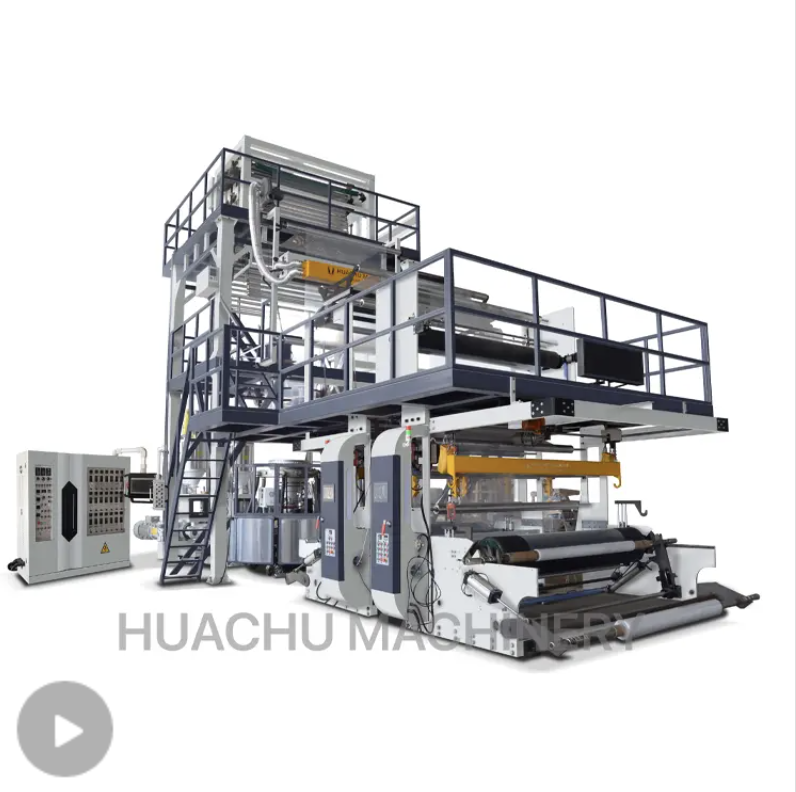
The production of blown film involves a more complex process. The plastic is extruded through a round die and inflated by air to form a tube of film. Once the material exits the die, it is inflated with air, creating a bubble that stretches both vertically and horizontally. This biaxial stretching helps enhance the strength and flexibility of the material. Blown films have distinct mechanical properties due to this stretching process, which makes them stronger and more flexible than cast films.
The Film Blowing Machine plays a crucial role in this process, controlling the inflation of the bubble and the cooling rate. Adjustments in air pressure, cooling rate, and extrusion speed help determine the final film’s thickness, strength, and flexibility. This gives manufacturers more control over the film’s properties, ensuring it meets the required specifications for different applications.
While the blown film process is more energy-intensive than the cast film process, it results in a film that excels in strength, flexibility, and durability. The process’s ability to stretch the material in two directions provides superior properties compared to cast films, which are typically stretched in only one direction.
Properties of Blown Film
● Strength and Durability: Blown films are stronger than cast films because the biaxial stretching process aligns the polymer molecules, improving tensile strength and resistance to tearing. This enhanced strength makes blown films ideal for applications like stretch wraps and heavy-duty packaging.
● Flexibility: The inflation and stretching process make blown film more flexible than cast film. This flexibility allows the film to stretch and conform to different shapes, which is essential for packaging that needs to wrap around irregular objects.
● Cling: Blown films have higher cling properties than cast films, which makes them ideal for applications such as shopping bags and stretch wraps, where film adhesion is important for securing products.
Applications of Blown Film: Blown films are widely used in packaging applications that require strength, flexibility, and resistance to tearing. They are commonly used in applications such as pallet wraps, agriculture films, and industrial packaging.
Table 2: Key Characteristics of Blown Film
Characteristic | Description |
Surface Quality | Slightly rougher than cast film |
Thickness | Thicker, with varying gauge |
Flexibility | More flexible and stretchable |
Cling | High, two-sided cling |
Applications | Stretch films, agricultural films, industrial wraps |
Advantages of Blown Film
● Puncture Resistance: The biaxial stretching process in blown film improves its resistance to punctures and tears, making it ideal for applications that need a high degree of durability, such as stretch films and agricultural covers.
● Flexibility: Blown film is more flexible and stretchable than cast film, making it ideal for products that need to conform to different shapes or provide tight seals around objects.
● Strength: The stretching process during production increases the film’s strength, particularly in the machine direction (MD) and transverse direction (TD). This makes blown film better suited for heavy-duty packaging.
Tip: Choose blown film for applications that require strength, flexibility, and resistance to punctures, such as stretch wraps and agriculture films.
Key Differences Between Cast and Blown Film
Surface Quality
The surface of cast film is typically much smoother than blown film, which has a slightly rougher texture. This smoothness is ideal for high-quality printing and lamination. Blown film, on the other hand, has a rougher texture due to the inflation process, but this gives it higher strength and flexibility.
Strength and Durability
Blown film is much stronger and more durable than cast film. The biaxial stretching process gives it better tensile strength, especially in the transverse direction (TD). Cast film, while smooth and precise, lacks the same mechanical strength.
Flexibility
Due to the stretching process, blown film is more flexible and stretchable than cast film, making it more suitable for applications that require flexibility, such as bags or stretch films.
Cost
The cast film production process is typically less expensive, particularly for thinner films produced in large quantities. Blown film, however, requires more energy and equipment to control the biaxial stretching process, leading to a higher production cost but better overall performance.
Table 3: Comparing Cast and Blown Film
Feature | Cast Film | Blown Film |
Surface Quality | Smooth, glossy | Slightly rougher, but stronger |
Strength | Weaker, more uniform | Stronger, more resistant to tearing |
Flexibility | Less flexible | More flexible and stretchable |
Cling | Low | High |
Cost | Lower production cost | Higher production cost |
Best Uses | Packaging, medical, consumer goods | Stretch wraps, agriculture, heavy-duty packaging |
The Role of Film Blowing Machines in Blown Film Production
How Film Blowing Machines Work
Film Blowing Machines are essential for producing blown film. They extrude plastic through a circular die, where the material is inflated with air, creating a bubble that stretches in both directions. These machines control factors like air pressure, cooling rates, and take-up speed, which are crucial for determining the final properties of the film.
Advantages of Film Blowing Machines
Modern Film Blowing Machines allow for precise control over the extrusion process. This gives manufacturers the flexibility to adjust the blown film properties to meet specific requirements, such as tensile strength, flexibility, and thickness.
Wenzhou Huachu Machinery Co., Ltd. is known for its reliable and efficient Film Blowing Machines, designed to optimize the production of blown films with enhanced properties. Their machines ensure that blown films are produced efficiently without compromising on quality.
Optimizing Film Production with Film Blowing Machines
By fine-tuning the settings of the Film Blowing Machine, manufacturers can achieve high-quality blown films for various applications. From adjusting air pressure to controlling cooling speed, the Film Blowing Machine gives full control over the final product’s characteristics.
Tip: When selecting a Film Blowing Machine, ensure it offers advanced features like precise control over cooling, air pressure, and extrusion speeds to achieve optimal film performance.
Conclusion
In summary, understanding the differences between cast film and blown film is essential for choosing the right material for your production needs. Cast film is ideal for applications requiring smooth surfaces and precise thickness, while blown film excels in strength, flexibility, and durability.
The Film Blowing Machine plays a crucial role in producing blown films with controlled properties, such as strength and flexibility. Companies like Wenzhou Huachu Machinery Co., Ltd. provide advanced Film Blowing Machines that ensure efficient production and high-quality results, helping manufacturers meet the specific requirements of their industries.
FAQ
Q: What is the difference between cast film and blown film?
A: Cast film is produced by extruding molten plastic through a flat die, then cooling it rapidly on a chilled roll, resulting in a smooth surface and uniform thickness. Blown film, produced by inflating a plastic tube with air, provides superior strength and flexibility due to biaxial stretching.
Q: How does the Film Blowing Machine impact blown film production?
A: The Film Blowing Machine extrudes plastic through a circular die and inflates it, controlling the stretching and cooling process to optimize film thickness, strength, and flexibility for specific applications.
Q: Which is better for packaging, cast film or blown film?
A: Cast film is ideal for applications requiring smooth surfaces and consistent thickness, like food packaging. Blown film excels in strength and flexibility, making it suitable for stretch films, agricultural films, and heavy-duty packaging.
Q: Why should I choose blown film over cast film for industrial use?
A: Blown film provides enhanced tensile strength, puncture resistance, and flexibility, making it more suitable for industrial applications like stretch wraps, agriculture films, and other heavy-duty packaging needs.
Q: Is there a significant cost difference between cast film and blown film?
A: Cast film is generally more cost-effective to produce, especially for thinner films. However, blown film offers superior performance in terms of strength and flexibility, making it the preferred choice for more demanding applications.


