In agricultural film production, “UV resistance” is not just a marketing word—it is the difference between a film that survives a season and a film that fails early in the field. Greenhouse covers, mulch films, silage wraps, and tunnel films all face long exposure to sunlight, heat, moisture, and mechanical stress. If the film formulation is correct but the structure is poorly built, UV additives may not perform as intended, mechanical strength may be uneven, and field performance becomes unpredictable. That is why the machine architecture behind the film matters so much. When manufacturers aim for stable UV resistance and consistent outdoor durability, an ABC Film Blowing Machine is often the most practical and controllable choice.
At Wenzhou Huachu Machinery Co., Ltd., we work with producers who want agricultural films that hold up in real sunlight conditions, maintain tensile strength, and keep stable thickness over long runs. From our experience, the reason ABC blown film lines are so effective is simple: three-layer co-extrusion gives you more control. You can design the film layer by layer—placing UV stabilizers where they are most needed, balancing stiffness and toughness across layers, and improving process stability without “overloading” one single formulation. In this article, we explain why ABC blown film machines are perfect for UV-resistant agricultural films, and how they help manufacturers build better performance while managing cost and production efficiency.
What is an ABC blown film machine?
An ABC blown film machine is a co-extrusion system that produces a three-layer film structure:
Each layer can have a different formulation, additives, and performance purpose. Instead of using one “all-in-one” melt blend, ABC co-extrusion allows manufacturers to engineer structure more precisely.
For agricultural films, this matters because outdoor performance is multi-factor:
UV resistance
tear strength and puncture resistance
thickness stability
heat management
barrier performance (in some film types)
mechanical handling and installation durability
A three-layer approach gives you a more reliable way to optimize these requirements.
Why UV-resistant agricultural films benefit from an ABC structure
UV resistance in agricultural films typically relies on additives such as UV stabilizers and anti-aging systems. But additives only perform as well as:
how consistently they are distributed
where they are positioned within the film structure
how stable the film thickness is in production
how well the film resists mechanical damage that accelerates aging
An ABC blown film machine supports this because it allows functional layering rather than forcing everything into one layer.
Key reasons ABC blown film machines are perfect for UV-resistant agricultural films
1 Better control of UV additive placement
In real outdoor use, the film surface receives the highest UV exposure. With an ABC structure, manufacturers can place UV stabilizers more strategically—for example:
This helps improve cost efficiency because you don’t always need the same additive loading in the entire film thickness. Instead, you can put performance where it matters most.
Practical result:
improved UV stability in sunlight exposure zones
better cost control in additive use
more consistent outdoor aging behavior
2 More uniform performance over long production runs
UV-resistant agricultural films require consistent thickness and stable gauge distribution. If film thickness fluctuates, UV performance and mechanical strength will also fluctuate. An ABC blown film machine helps stabilize film behavior because each extruder can be tuned for its layer function, reducing the need to “force” one formulation to do everything.
For manufacturers, that means:
more stable output quality
less scrap from thickness deviation
easier control of film properties batch to batch
In agricultural film orders, consistency matters because farmers and contractors install large areas of film and need predictable performance.
3 Better mechanical strength balance for field durability
Agricultural films face:
wind load and flapping
stretching during installation
puncture risk from soil, stones, and crops
tearing at edges and fixing points
With ABC co-extrusion, you can design the film so that different layers contribute different strength characteristics:
one layer improves toughness
another improves stiffness
another improves tear resistance
Instead of overcompounding one blend, ABC structure makes it easier to achieve balanced performance without sacrificing process stability.
4 Improved resistance against micro-damage that accelerates UV aging
UV aging doesn’t only come from sunlight—it accelerates when the film develops micro-cracks, scratches, and stress zones. When a film has poor mechanical balance, it damages more easily, and UV exposure then “finishes the job.”
ABC co-extrusion helps reduce this risk by supporting a stronger, more stable structure, which in turn:
reduces micro-tearing during handling
improves puncture resistance
keeps film integrity longer in the field
This is one reason ABC structures often show better real-world outdoor durability than simple single-layer films, even when formulations are similar.
5 Flexible formulation strategy for different agricultural film types
Not all agricultural films are the same. UV-resistant requirements differ across:
greenhouse film
mulch film
silage film
low tunnel film
wrapping and cover film
An ABC Film Blowing Machine supports flexible formulation strategies because each layer can be adjusted without redesigning the entire film.
Examples of practical flexibility:
adjust outer-layer UV package for longer service life
change core layer for strength or cost optimization
add functional additives (slip, anti-block, anti-fog) in specific layers
This flexibility makes it easier for producers to respond to different customer needs without changing the full line setup.
6 Cost efficiency through layer optimization
UV additives and specialty stabilizers can be expensive. ABC structure often helps reduce total cost because it allows:
targeted additive placement
thinner functional layers with higher additive concentration
cost-optimized core layer material strategy
This approach can produce a film that performs better in outdoor exposure while using additives more efficiently.
Table: How ABC blown film design supports UV-resistant agricultural films
Production Goal | ABC Machine Advantage | Practical Benefit |
Strong UV resistance | place UV package in outer layers | better sunlight aging control |
Stable thickness | layer-by-layer process tuning | consistent film quality |
Toughness + stiffness balance | functional layer design | better field durability |
Lower additive cost | targeted additive use | improved cost efficiency |
Flexible product range | adjust layers separately | easier to meet different film demands |
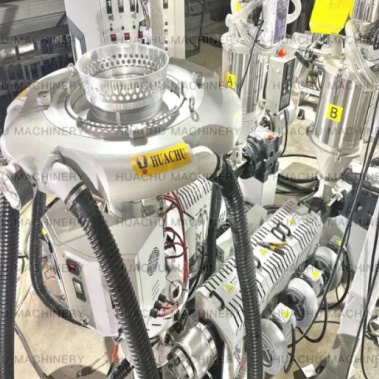
What to look for in an ABC film blowing machine for agricultural film production
To maximize the benefits, we recommend focusing on machine features that support stable production control:
1 Stable extrusion and melt control
Consistent melt flow is essential for stable layer ratio and thickness.
2 Reliable die and air ring system
Bubble stability affects thickness distribution and film strength uniformity.
3 Good cooling and take-off stability
Agricultural films often run at high output, so cooling and nip control influence film clarity and stability.
4 Accurate layer ratio adjustment
ABC performance depends on how precisely you can control the A/B/C ratio for different product designs.
5 Automation and monitoring
Thickness stability and parameter control improve repeatability and reduce operator dependency.
Common mistakes in producing UV-resistant agricultural films (and how ABC helps)
Mistake 1: Putting all additives into one single layer film
This often causes cost inefficiency and performance imbalance.
Mistake 2: Ignoring thickness stability
Even a strong UV package cannot compensate for uneven film gauge distribution.
Mistake 3: Trying to solve durability only by increasing thickness
Thicker film may help, but structure and layer performance can often deliver better results with smarter material use.
ABC co-extrusion supports a more engineered solution instead of brute-force adjustments.
Our approach at Wenzhou Huachu Machinery Co., Ltd.
At Wenzhou Huachu Machinery Co., Ltd., we recommend ABC blown film solutions because they allow agricultural film producers to build performance by design. We focus on helping customers match:
film type and target service life
UV resistance goals
mechanical strength requirements
output and stability expectations
In our experience, the most successful UV-resistant agricultural film projects are those where the machine capability supports flexible structure design—so producers can refine film performance over time rather than being limited to one fixed formulation approach.
Conclusion
UV-resistant agricultural films succeed when structure, formulation, and process stability work together. An ABC Film Blowing Machine is perfect for these applications because it gives manufacturers control over layer function, UV additive placement, mechanical balance, and thickness stability. The result is more consistent outdoor durability, better film performance in real field conditions, and more efficient use of costly UV stabilizer packages.
To learn more about ABC blown film machine solutions for UV-resistant agricultural film production, you are welcome to contact Wenzhou Huachu Machinery Co., Ltd. for more information.
FAQ
1) Why is an ABC Film Blowing Machine better for UV-resistant agricultural film than single-layer lines?
Because it allows targeted UV additive placement and better mechanical balance across layers, improving durability and cost control.
2) Which layer should contain most UV stabilizers in an ABC film?
In many designs, UV stabilizers are concentrated in the outer layers that face sunlight, while the core layer focuses on strength and stability.
3) Can ABC blown film machines produce different types of agricultural films?
Yes. ABC co-extrusion supports greenhouse films, mulch films, silage films, tunnel films, and more by adjusting layer ratios and formulations.
4) Does ABC structure help reduce production scrap?
Often yes. Better bubble stability and layer control can improve thickness consistency, reducing off-spec film and waste.


