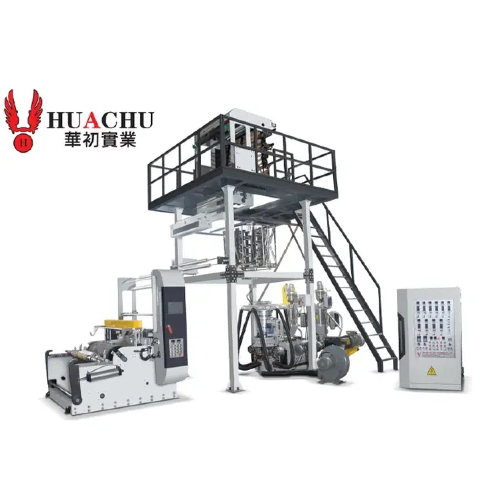
Film blowing machines are essential tools in the plastic industry for producing thin, flexible plastic films. These machines work by extruding molten plastic through a circular die, which is then inflated into a thin film bubble that is cooled and flattened. The versatility of film blowing machines allows them to produce a wide variety of plastic films for diverse applications such as packaging, agricultural films, and industrial films.
Co-extrusion technology is a significant advancement in film blowing, allowing multiple layers of different materials to be extruded simultaneously to form a single, multi-layered film. This process enhances the properties of the resulting film, such as barrier properties, strength, and flexibility, making it suitable for a wider range of applications.
This article focuses on two popular co-extrusion configurations: AB and ABA. Both configurations are used in film blowing machines, but they differ in the number of layers and their respective applications. We will delve into the structure of both AB and ABA film blowing machines, compare their advantages, and explore their uses in various industries.
1. What is Co-extrusion in Film Blowing Machines?
Co-extrusion is a process in which multiple layers of materials are extruded simultaneously to form a single film. Unlike traditional single-layer film extrusion, where only one material is used, co-extrusion allows for the combination of different materials, each with unique properties, to create films with enhanced characteristics.
In co-extrusion film blowing machines, materials are fed into separate extruders that are connected to a common die. The molten plastic from each extruder is layered on top of one another to form a multi-layered film. These films often combine materials such as LDPE (Low-Density Polyethylene), HDPE (High-Density Polyethylene), LLDPE (Linear Low-Density Polyethylene), and other specialty resins to achieve specific properties, including better moisture barriers, improved strength, and UV resistance.
The advantages of co-extrusion in film blowing machines include:
Improved Film Properties: Co-extrusion enables the creation of films with enhanced mechanical strength, flexibility, and barrier properties.
Material Efficiency: By combining different materials, manufacturers can optimize production costs and reduce waste.
Customizability: Manufacturers can create films with specific properties based on the requirements of the end product.
2. The Co-extrusion AB Film Blowing Machine
The AB film blowing machine is one of the simplest configurations in co-extrusion film blowing. It uses two layers: an outer layer (A) and an inner layer (B). The outer layer (A) is typically made of a more durable and flexible material, while the inner layer (B) may serve a different function, such as enhancing barrier properties, reducing production costs, or improving the film's overall structural integrity.
Structure and Design of AB Film Blowing Machines
In an AB configuration, the extruder for the outer layer (A) and the extruder for the inner layer (B) are combined into one machine. The film produced has two distinct layers:
Outer Layer (A): This layer is often made from high-quality resin, which provides the film with essential properties like strength, durability, and resistance to wear and tear.
Inner Layer (B): This layer is typically used to provide additional functional properties, such as moisture or gas barriers, and may use less expensive or recycled materials to reduce production costs.
Applications of AB Film Blowing Machines
AB co-extrusion machines are suitable for producing a wide variety of films, including:
Flexible Packaging: Films produced by AB machines are commonly used for packaging materials like snack foods, dairy products, and non-food packaging, as they provide both strength and cost-efficiency.
Non-food Packaging: These machines are also used in the production of durable films for industrial and consumer products.
Key Features of AB Film Blowing Machines
Cost-effective: By using a less expensive material in the inner layer, AB film blowing machines offer a more affordable solution for producing high-quality multi-layer films.
Versatile Applications: AB machines are suitable for a broad range of applications, including flexible packaging, agricultural films, and industrial applications.
Simple Design: The simplicity of the AB configuration makes it easier to operate and maintain.
3. The Co-extrusion ABA Film Blowing Machine
The ABA film blowing machine is a more advanced configuration that uses three layers: two outer layers (A) and one inner layer (B). The ABA configuration provides more flexibility in creating films with specialized properties, as different materials can be used in each layer to achieve the desired characteristics.
Structure and Design of ABA Film Blowing Machines
In an ABA configuration, the outer layers (A) are often made from durable, high-quality materials, while the middle layer (B) can be composed of materials that offer barrier properties or are less expensive. The resulting film has three distinct layers:
Outer Layers (A): These layers provide strength, durability, and resistance to external factors such as UV radiation, oxygen, and moisture.
Middle Layer (B): This layer can be used to enhance the film's barrier properties or to reduce production costs by incorporating recycled or lower-cost materials.
Applications of ABA Film Blowing Machines
ABA co-extrusion machines are often used for applications that require high-performance films, such as:
High-performance Barrier Films: The combination of materials in ABA films allows for the creation of films with excellent barrier properties, making them ideal for food packaging, medical packaging, and electronics packaging.
Food Packaging: ABA films provide a longer shelf life for perishable products, thanks to their enhanced moisture and oxygen barrier properties.
Agricultural Films: The ABA configuration is commonly used for films that require UV resistance and temperature regulation for agricultural applications.
Key Features of ABA Film Blowing Machines
Enhanced Barrier Properties: The ability to use three distinct materials provides superior barrier performance against moisture, oxygen, and UV light.
Customization: ABA machines allow for greater customization of film properties to meet specific application requirements.
Increased Durability: The extra layer of protection provided by the ABA configuration results in more durable films that are less prone to damage during handling.
4. AB vs. ABA Film Blowing Machines: Key Differences
The AB and ABA film blowing machines each have their own advantages, depending on the application and required film properties. Below is a comparison of their key differences:
Feature |
AB Film Blowing Machine |
ABA Film Blowing Machine |
Number of Layers |
2 (one outer layer, one inner layer) |
3 (two outer layers, one inner layer) |
Material Flexibility |
Less flexible in material choice |
Greater flexibility for material selection |
Barrier Properties |
Suitable for basic barrier properties |
Superior barrier performance (moisture, oxygen, UV) |
Customization |
Limited customization |
High customization for various functions |
Applications |
Flexible packaging, non-food packaging |
High-performance packaging, food packaging, agricultural films |
Cost Efficiency |
More cost-effective |
Higher cost due to added complexity, but enhanced performance |
5. Applications of AB and ABA Film Blowing Machines in the Industry
Both AB and ABA film blowing machines serve critical roles in the production of specialized films for a variety of industries. Here’s a look at their key applications:
AB Film Blowing Machines are commonly used in:
Flexible Packaging: Often used for less demanding packaging applications like snack bags, wrappers, and non-food items.
Non-food Packaging: Ideal for industrial packaging, such as packaging materials for electronics, textiles, and other consumer goods.
ABA Film Blowing Machines are typically used for:
Food Packaging: The ability to provide superior barrier properties makes ABA films ideal for packaging fresh food and other perishable items.
Agricultural Films: Used for greenhouse covers, mulch films, and other agricultural applications that require enhanced UV resistance and moisture control.
Medical and Electronics Packaging: The high-performance barrier properties of ABA films make them perfect for protecting sensitive products like pharmaceuticals and electronics.
6. Advantages of Choosing the Right Co-extrusion Machine
Choosing between an AB and ABA film blowing machine depends on various factors, including the type of film required, performance characteristics, and production costs. Here’s a guide to selecting the right machine:
AB Film Blowing Machine is ideal for cost-effective solutions when you need a two-layer film with basic barrier properties or for general-purpose packaging.
ABA Film Blowing Machine is better suited for applications requiring high-performance films with enhanced barrier properties, such as food packaging, medical packaging, and agricultural films.
It’s essential to evaluate your specific needs in terms of film properties, production volume, and material costs when making the decision.
7. Conclusion
In conclusion, both AB and ABA film blowing machines offer distinct advantages based on the specific needs of the end product. AB machines are a more cost-effective solution for producing simple, two-layer films, making them ideal for standard packaging applications. On the other hand, ABA machines, with their advanced three-layer configuration, provide superior performance, particularly for applications that require enhanced barrier properties and durability, such as food packaging, medical packaging, and agricultural films.
At Wenzhou Huachu Machinery Co., Ltd., we specialize in manufacturing high-quality AB and ABA film blowing machines tailored to meet diverse production requirements. Whether you need a cost-efficient solution or a high-performance machine, our team is committed to providing the best equipment to suit your needs. By choosing the right machine, you can optimize your production process and ensure the highest quality output.
If you’re looking for guidance on selecting the right film blowing machine for your business, feel free to contact us. Our experts are ready to help you make an informed decision and provide tailored solutions that align with your production goals.
8. FAQ
What is the key difference between AB and ABA co-extrusion film blowing machines?
The primary difference lies in the number of layers: AB has two layers (one outer, one inner), while ABA has three layers (two outer and one inner). ABA films offer better barrier performance and customization.
Which type of co-extrusion machine is better for food packaging?
ABA co-extrusion machines are ideal for food packaging as they provide superior barrier properties, which help extend shelf life and preserve product freshness.
How do AB and ABA machines compare in terms of material cost efficiency?
AB machines tend to be more cost-efficient due to their simpler structure and fewer layers, while ABA machines may incur higher initial costs but offer better material optimization and performance.
Can AB and ABA machines be used for the same applications?
While both can be used for flexible packaging, ABA machines are preferred for high-performance applications requiring advanced barrier properties, such as food packaging and agricultural films.
What factors should I consider when choosing between AB and ABA film blowing machines?
Consider factors like required film properties (strength, barrier performance), application type (food, industrial, agricultural), and production costs when choosing between AB and ABA machines.


